Showing posts with label worst practices. Show all posts

Thursday, January 24, 2008

Some People Just Don't Get It

The other day I wrote about my furnace repair guy who had an instinctive understanding of how to monitor and measure his marketing activities. It might have sounded like an overstatement to say that he was better at this than some marketing pros. Not really.

Just after the furnace fun I put an ad on Craigslist looking for somebody to do SEO work. The ad explained what we were looking for in a couple of paragraphs, how we'd want to relationship to work between us, an SEO person, and our clients, and requested that people in a specific geographic area only respond.

Five minutes later I got my first response: someone sending me his graphic design portfolio, with an LA phone number. (LA was not the location specified.)

His work wasn't bad... but I wasn't looking for a graphic designer, and he apparently hadn't read the ad. (The response came so quickly that I wondered if he had some method of monitoring Craigslist postings and sending automated replies.)

Then I got something from somebody else, in the wrong place, that instead of telling me anything about him, said basically "Why did you specify that location in the ad?" (Um, because I want someone in that location?)

Last night I got something from a company in India, and this morning I got something from somebody with a Yahoo address that told me about his or her SEO work, but did not have a link to their site, a name, anything.

People who do SEO are, one would presume, marketing oriented people. Wouldn't you think they'd have some idea how to present themselves?

Here are the basic, Marketing 101 rules that they broke.

  • When you're pitching for business, have a name on your email. If the "From" field reads "Big Honking SEO Company," I don't feel like I'm hearing from a person, I feel like I'm talking to an autoresponder, and I don't want to do that.
  • If I mention specific things I need someone to do, tell me about how you do them, have done them, and are prepared to do them again. A sentence or two would be fine.
  • Give me some option besides contacting you. A link to your site, a portfolio, or your blog would do it. Let me find out more about you.
  • If I say "Houston area only" and you're in California, Idaho, or Bangalore, don't reply. Or, if you do, tell me why: "I'm in Los Angeles, but I work with clients all over the country, and I'm sure I can help you" is actually enough to tell me that you at least read the ad. "I'm in Miami, but I have some clients in Houston and visit once a month, and I'm sure I'd be able to work with you long distance." Just let me know that you heard what I said, you understood it, and you have some reason to think that maybe I'll be interested anyway. If you ignore what I say, what's going to happen when a client tells us what they need?

This is not complicated stuff. I just want to know that you heard me, you understood me, and that you are responding to what I asked. But it's very important. If you can't comprehend what I asked you and reply appropriately, do you think I want you with a mile ofmy clients?

And these are people who are supposed to be providing marketing services. Scary. I'd rather have the furnace guy take a crash course in SEO and put him to work on it; knowledge can be acquired, but the ability to listen and think is usually either there, or not.


Thursday, January 17, 2008

How Marketers Lie to Themselves: "They Love Our Advertising!"

Mary Schmidt has a post up about one of the great marketing delusions: the idea that people just love, love, love seeing ads all the time.

Commenting about Microsoft's concept of streaming ads to shopping carts in the grocery store, complete with RFID so it can tell you about Pop-Tarts when you're in the breakfast aisle - because heaven forbid you have a few minutes in the day to just be lost in your own thoughts! - she writes:

The corporate bla-blah speak justifying streaming video ads to shopping carts is classic: “This is not all necessarily about bombarding consumers, about targeting advertising,” said Scott Ferris, general manager of Microsoft’s Advertiser and Publisher Solutions group. “It’s about also making the shopping experience better for the consumer.”


No it's not. It's about selling more stuff.

People are actually quite tolerant of advertising. They are, however, not stupid, and when you tell them that the reason your shopping cart is getting in your face with ads is to improve your quality time at the store, they are likely to think, "What kind of moron do you think I am?"

For example, does Forbes think they're fooling anyone with this?

forbes-welcome.png

"Skip this welcome screen?" It's not a welcome screen, it's an ad. I know that. I get it. Free content, ads. Fine. But every time I click on a link to a Forbes article and see that, I think - yes, that's right - "What kind of a moron do you think I am?"

This is what every marketer needs to remember:

1. When you're beaming a one-way message at someone to get them to buy something, it's an ad. I don't care how you send it, what the medium is, how much you drape it in trappings of social media, or how much you personalize it. It's an ad. That's OK, but don't forget it.

2. People don't really want to hear it. In the case of Forbes, they want to read an article, not an ad. In the case of the shopping carts above, people just want to buy their Cheerios and milk and bananas and go home.

3. So if you want people to pay attention to your ad, it needs to be useful, entertaining (or at least interesting), and not annoying.

People are remarkably tolerant of ads, even as they invade every bit of our mental space, and when they're very good they are treated like valuable cultural artifacts. But they are not tolerant of being treated like idiots.

You're a marketer. Don't delude yourself into thinking that there's a world full of consumers sitting there thinking, "I wish my shopping cart would tell me about the special on Acme Fried Sugar Crisps" or "Oh, Forbes is welcoming me - they're so friendly!" Just do your job and show some basic respect for peoples' intelligence.

Oh, and on that shopping cart thing - it's just the incentive I need to check out the farmer's market up the road I keep hearing about. It used to be that the worst thing about shopping was annoying muzak. Now, instead, a trip to Kroger is an assault on the senses. There are constant chirpy announcements about what I should be buying. There are screens on the registers showing videos and animations, and making beeps and boops that always make me think my phone is chirping at me - "Did I just get a text message? No, it's the $@#$#@ register again."

My big complaint about all of this is quite simple: everyone is so busy bombarding us with some message or another that there's less and less time to just be with yourself. You know - to daydream, to think about what you'll do later in the day, to suddenly wonder about that old friend you haven't heard from in years, to be struck by a creative idea. I am a marketer, but I do believe that all of these new methods of interruption marketing are basically making us into a group of stupider and stupider people.

I also think it's annoying people, and eventually the backlash will come. Professions that don't have the common sense to restrain themselves wind up being restrained by somebody else. We get what we ask for.

Saturday, December 22, 2007

A Simple Technology Rule: Use it to Talk to Customers

This seems obvious, right? We've got all of this old technology (like phones), not so new technology (email, your web site), and cutting-edge stuff (social networks) available, and so we should use it to improve communications with our customers. Improvement means not just talking in more ways, but more useful ways. We can make it easier for customers to find the right people in the organization to help them. We can put useful information at their fingertips. We can help would-be customer evangelists spread the word.

Or, we could not bother. I experienced an example of this with Washington Mutual, the bank whose ads position them as the happy bank with a human face where you don't have to go through layers of bureaucracy to get help.

The other day I got an email from them about a business account, informing me that my phone number had been changed. The problem was, I hadn't changed any phone number with them, and the number now on my account was not mine. (It was a number of mine with one digit changed - weird.)

My first thought, of course, was that the security of my account might have been compromised. The email ended with a note that if I had not made this change, I should call an 800 number right away.

Which is precisely what I did. Did that 800 number take me to a security department that could figure out what was going on? Or at least to a person, because obviously this problem required human intervention?

Oh, no. "Welcome to Washington Mutual! Para informacion en espanol...."

I was at the top level of the main service menu. And a funny thing about WaMu's main menu: there is no option that sounds right for "I think my account security has been compromised." And there is no option to speak to a person. (Hitting "0" gives you a "bad customer, that wasn't a choice!" option.)

Is that really the experience you want a customer to have when they are sitting there wondering if someone's gotten into their account and is taking their money?

I eventually chose the option to find out about recent transactions, and then intentionally entered an incorrect access code, which bounced me from voicemail to a person, who had no idea how my phone number got changed (but did reset my password).

The very next day, I had an almost identical experience with them when I tried to activate a new ATM card on the web. I got an error message indicating that the information I entered didn't match what they had. So I went through the same "no menu option makes sense for what's happening" hassle, eventually got a person who activated my card (and verified that all the information I entered did indeed match what they had).

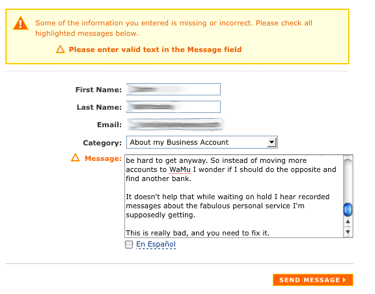
I am the customer who lets a company know when something is wrong, so I clicked the "contact us" link on their web site, and wrote a short message in the form provided to tell them that it's not okay with me that when there is a potentially serious problem, I'm shunted to a voicemail system offering me no useful options or a way to get a person easily. (How hard is it to set up a special 800 number?) And that these two experiences left me feeling very unsure whether any of their IT systems works properly and my money is safe with them.

I was pleased to find that form; far too many companies still have web sites designed to prevent customer feedback: no forms, no email addresses, or forms that are designed to let customers only submit structured information that the company wants to hear, rather than other feedback from customers who care enough to tell them what's going on. Okay, I thought, score one for WaMu.

And then I clicked send.

wamuhell.png

The form doesn't work. I tried in two different browsers in case I was having some browser-specific issue. You can't talk back to them.

This is such basic stuff. There are still a whole lot of companies out there who, before they try to tackle new media, or spend money on ads about how friendly and approachable they are, need to do the basics: create a web site that makes interaction with customers easier, not more frustrating for them.

Saturday, December 15, 2007

Stupid Ideas Die Hard

I just received a call - on my cell phone - that was a prerecorded message offering me a certificate for a discount on services from the Durrett Chiropractic & Natural Health Care Clinic here in Houston.

Apart from the little detail that this call was illegal - the number is on the national do not call list and I have no relationship of any kind with these people - I have to wonder: Who thought sending prerecorded ads to people's phones was a good way to get new customers? Did they think someone would say, "Oh, hey, I've been wanting to see a chiropracter and these folks must be good - after all, they called my cell phone with an ad!"

It actually annoyed me enough that I filed an FCC complaint (it's really fast to do it via the web).

My guess is that someone convinced them this was a good idea and charged them money to execute the campaign. And poorly - the ad consisted of rapid-fire speech with bad enunciation. I couldn't tell what the name of the practice was (but reverse lookup solved that). If you're going to get in people's faces in obnoxious ways, at least say your name clearly.

It's amazing to me that people still do this stuff. Dear Durrett Chiropractic people, people fire the folks giving you marketing advice ASAP.

Tuesday, November 27, 2007

Stop, Thief!

Dwight Silverman at the Houston Chronicle writes about how he had to call Microsoft and reactivate his copy of Vista because he made too many hardware changes to the machine it was running on. The twist is that it was a virtual machine (he's running Vista virtually on a Mac) and one of the benefits of virtualization is that you can change the "hardware" configuration of machine at will. (Got a memory intensive task? Bump up the memory. When done, reduce it again. Etc.)


This of course trips up Vista, which decides that the machine has been tinkered with too many times and thus is not really the same machine on which it was installed... so it stops working properly until you call Microsoft to explain that you are a real customer, not a thief.


I'm surprised people accept this so meekly (check out the comments to Dwight's post). Products that stop working when you buy them and use them legally are not well-designed products. It's a bit like having a car that periodically stops running unless you scan a copy of your title documents into it.


I understand Microsoft's wish to reduce piracy of its products; that's perfectly legitimate. But isn't there a better way than treating your customers like thieves, making them prove that they did not steal the product?

Thursday, November 15, 2007

Whole Foods Makes a Whole Mistake

I understand why the Whole Foods board decided to ban company executives from blogging or commenting on any non-Whole Foods site, a decision that Houston Chronicle business writer Loren Steffy talks about on his blog. But it's the wrong decision.

Whole Foods CEO John Mackey got in hot water, you may remember, for posting about the company's battle to buy competitor Wild Oats without identifying himself.

Steffy calls the new policy "stunningly obvious," but it's not. Yes, it's stunningly obvious that executives should not be revealing non-public information or pretending to be someone else in their online activities.

But no online participation anywhere outside of the the company's own sites? That's a mistake. Don't you want your people to be establishing an online presence, networking, and showing their thought leadership in relevant communities?

That's like telling the Wall Street Journal, "Sorry, you can't speak to Mr. Mackey, you're not a Whole Foods publication." PR folks have been getting angling to get executives into publications forever, because there is a real benefit. The benefits in the world of social media are similar, and Whole Foods is making a mistake by locking up their top people online.

Sunday, November 04, 2007

You Have Got to be Kidding Me

Next week I'm heading out to Las Vegas to attend BlogWorld Expo, so tonight I'm looking through the list of exhibitors to decide who I really want to make sure I see. And on the list is a company called Entrecard. I've never heard of them. When you click the link on the event site to find out who they are, this is what you see:

That's it. That's the whole thing. No links, no explanation, just "Hey, give us your email address!" (My first thought was, "Drop this, losers.")

Honestly, there are good landing pages and bad landing pages but there's also another category I can most kindly call "idiotic."

I don't know who these people are are, I don't know what they do, but I'm supposed to give them permission to bug me? I think not. Work with me here, people. I'm going to be there; all you have to do is pique my interest so I'll spend five minutes at your booth, thereby giving you the opportunity to wow me. You're not even trying.