Showing posts with label social media. Show all posts

Tuesday, January 15, 2008

Twitter: Cool, but Not Ready for Prime Time

If you use Twitter regularly, you've probably noticed that it's not the most reliable of web apps. Yes, it's free, and sure, you have to expect some glitches... but compared to other services, it's pretty dicey.
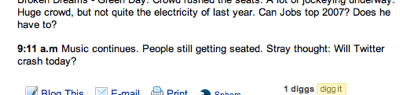
We are getting a demonstration of that right now. I'm looking at ZDNet's updating blog page of Macworld keynote reports and I saw this shortly after it started:

willtwitterfail.png

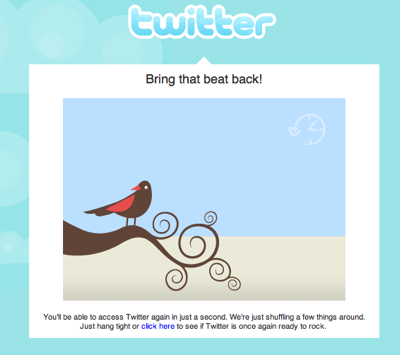
Sure enough, a few minutes later...

ohyesitwill.png

(Twitter did indeed come back in a few seconds, as the message promised - but only in that there was a page there. No new tweets on it - it seems to just not be updating anymore, which frankly is no more useful than the error page.)

I like Twitter, but I have to say, I'd never make it the centerpiece of any time-sensitive social media strategy. You just never know when everybody is going to see an overly-cute "Oops! It's broken!" message instead of the application itself. Given that its makers appear to have no plans to make it into a sustainable enterprise (read: something with money to invest in infrastructure), this is unlikely to change.

It's a great concept, though, that will probably be implemented much better at some point. Maybe by Twitter, but quite possibly not.

Out With the Old New Thing, In With the New New Thing!

Things move fast in the world of social media. So fast, in fact, that Tuesday's hot new thing is often Friday's old news. So I chuckled when I read my first Twitter is, like, so yesterday post.

I am SO sorry for writing this, I L-O-V-E Twitter. Love it! I’m just so sorry to say, Tumblr replaces it. It’s that simple. Tumblr is to the iPhone what Twitter is to the pager. I know, I know. I love Twitter and I have been obsessed with it for almost a year now so I KNOW what Twitter is supposed to be, thank you - it’s SUPPOSED to be like a pager, that’s the DNA of what Twitter needs to be to do “microblogging”…I once said. And Pownce (which I love too!) and Jaiku (which I neglect, Im so sorry!), are all not what I’m talking about either, Twitter does best what those other apps do.

Tumblr, on the other hand, is enhanced in the right way and thus, unfortunately, and yet also for the better, replaces the need for Twitter all-together. This is going to be hard for people to see because Pownce could be seen as an attempt to enhance Twitter but actually Powence further illuminated the superior simplicity of Twitter, i.e. that the kind of enhancement doesn’t work. Perhaps unwittingly, and more likely just consequently, Tumblr enhances Twitter in the right kind of way.


The missing piece here - the right kind of way for what? I like Twitter because it's incredibly simple and people I know use it. Tumblr does more, but it's nothing that I want to do or am not doing elsewhere. (Obviously, this isn't true for the writer above... and that's fine.)

I have a Tumblr account, by the way; I'm not linking to it here because I'm boycotting anybody who drops the "e" from "er." No, not really; there's just nothing there, so there's no point in pointing anybody at it.

Finding a use for the next social media tool is, to be blunt, not high on my list of priorities. The tools need to find my needs; if I don't have an unmet need, I'm not interested.

And that's the bigger point: the platform du jour for blogging, microblogging, sharing links and feeds, and so on will change tomorrow, and next week, and next month. As any IT product marketer knows, feature advantages are incredibly hard to maintain; fortunately, they're not usually the point.

Twitter, for all its popularity, is something that a couple of Google developers could recreate in an afternoon and have live in a week. (And it would probably be more reliable on day one than Twitter, which always has the feeling of being held together with duct tape and prayers.) What Google couldn't duplicate that quickly is the user base.

Here's what matters for all of these tools: do people find something useful to do with them? Do they have a critical mass of users? And finally, perhaps most importantly, are the information and network links in them accessible from the outside world?

The nice thing about most of these platforms is that if you don't care to become a hardcore user, you can still get what you need from them through search and RSS feeds. I think we're going to see people get less interested in investing time and effort into using them if that's not possible (hi, Facebook!).

The missing piece is the social graph. If you've got a network of links to others in LinkedIn or Facebook or Twitter, that doesn't move easily somewhere else. That's got to change.

Saturday, January 05, 2008

Social Networking: Focus Matters

Kim Hart of the Washington Post wrote about niche social networking sites, and why they may be more appealing for marketers:

Overall, ad spending on social-networking sites is expected to grow 75 percent next year, to $2.1 billion, according to eMarketer, a research firm that tracks online advertising. With more than 110 million active profiles on MySpace and 59 million on Facebook, those sites still attract the lion's share of attention and money, winning more than 70 percent of all U.S. social-network ad spending in 2007, according to eMarketer.

But smaller sites' share of that money is growing. Of the $920 million spent this year to advertise on social networks, 8.2 percent went to niche sites, up from 7 percent in 2006, according to eMarketer. Next year, niche sites' share of ad revenue is expected to grow to 10 percent, according to an eMarketer report released this month.


That shouldn't surprise anybody. More focused online communities are likely to attract more targeted audiences. Users are also likely to spend more time there and be more loyal to them, whereas there's a flavor of the month feel to MySpace and Facebook. (Facebook in particular seems intent on alienating its users, whether it's through creepy tracking and public revelations of personal information like Beacon, using members' pictures in ads, or ham-handedly insisting that user's personal data belongs to them. I think the clock is ticking for them.)

Smaller sites are also more likely to have the flexibility to work with marketers to create customized advertising programs. Users are more likely to care who's supporting their beloved online forum.

The main value that large networks like Facebook bring is the ability to keep track of social connections. But we're already seeing others trying to build those capabilities into things like email, contact management, and calendar applications. That will continue, and the value proposition for something like Facebook for its users is likely to weaken. When social networking is an omnipresent feature, no a destination, those smaller networks and sites become even more important - and if you're already there, you'll be ahead of the game.

Tuesday, January 01, 2008

Everything's Social, Like It Or Not

I've been a big fan of Google's Gmail service for a long time. Some of the reasons for my enthusiasm about it are obvious: the massive storage (a new idea when it was introduced), and the excellent search capabilities. Another big plus for Gmail: the interface. Whereas Yahoo Mail and Hotmail and AOL were making otherwise very good services quite unpleasant to use by bombarding users with ads, headlines, and all kinds of other extraneous information that had nothing to do with the simple task of reading and writing mail, Google gave us their standard text-oriented, plain as can be interface. And I loved it.

So I'm reading about some of the new features that are coming with dismay.

One of the reasons why the chat box can no longer be disabled in the new version of Gmail is that it will include some new features: updates from your contacts. Yes, they are the same contacts you barely know, but these updates will help you learn more about them.


I don't really want automatic updates from my contacts. I do want information that my contacts decide they'd like to share with me, because they know me and think I will find it useful.

Are any of us suffering from a lack of information right now? I don't think so. The big challenge of all of these tools is finding the good stuff. While developers work hard to figure out ways to create intelligent filters to accomplish just that - and often do some pretty ingenious things - I can't help but think that there's already a good social network filter out there: the human brain.
Specifically, the human brains residing in the skulls of people who know us. When I get an email from my colleague Maureen that says, "I thought you'd find this interesting," I pay attention. But I realize that Maureen has probably looked at fifty other things that did not make her think, "Hey, I should pass that on to John."

If I had a lot of time and not enough to do, I probably would enjoy sorting through those. I don't have that, and I doubt you do either.

Now, tools for sharing are great; the shared feeds in Google's newsreader are a great example. Those are resource that are out there for us to choose to go look at.

But I'm not thrilled at the idea of them appearing in my beloved simple Gmail interface. When I'm there, I'm there to accomplish a specific task, and I want to be left alone.

It seems that the trend in social networking is not to create tools to allow selective information sharing, but to enable to broadcast all kinds of information to their contacts - sometimes automatically. I think that degrades the quality of information one gets through networks. (Facebook's Beacon is a great and disastrous example of this.)

Am I hopelessly over 40 about this?

Thursday, December 20, 2007

Social Media and Marketing - Cousins, Not Twins

Chris Brogan has a good post up about why social media is not a form of marketing:

Here’s where I’m going with this: marketers trying to come into social media and rapidly become versed in the tools and believe what they’re doing is social media, are probably doomed to a lot of pain and disappointment along the way. Marketers who come into social media and feel that these tools will deliver the same kinds of clean stats and clear cut wins and campaign thinking overall are doomed as well.

Marketing is a discipline with lots of emphasis on channel thinking, on campaigns, on message shaping, on control and covering all the bases.

Social media is a set of tools that permit regular people access to potential audiences of shared interest. These tools give voice, give preference, give rise to individuality, give flexibility, collaborative opportunity, and a whole lot of other things that don’t resemble traditional marketing the same way gym class felt absolutely nothing like social studies.

Marketers have tools. They understand what they do very well. They understand lead acquisition, and brand strategy, and all kinds of things that the folks who use social media tools could really do to understand before knocking.


The other day I wrote about how Twitter is often used in ways that may be useful, but that take it outside the realm of social media - because when you use it to broadcast, it's not longer social, it's just a medium. That's something for marketers to think about as they wrap their arms around any social medium.

It all comes back, I think, to things Seth Godin was saying a long time ago about interruption marketing versus permission marketing. We marketers have an astonishing ability to turn everything into interruption; whether it's email campaigns that don't bother with personalization and - the ultimate email crime, in my view - deliver messages to which the user can't reply, or using YouTube to blast something out without paying attention to what viewers are saying, to using Twitter as a handy way to get ads to someone's SMS mailbox.

There's no question that social media are useful marketing tools. The challenge, of course, is using them as social media.

When you have a hammer, every problem is a nail; when you're a marketer, sometimes every problem is sneaking a message in front of an eyeball. From the user point of view, the most successful social media are likely to be those that let users take unwanted nails and jab them back into the marketer's eyeball. Those that turn into marketing vehicles (hi, Facebook!) are likely to be abandoned by users.

Here's the challenge for savvy 21st century marketers, or those that want to be them: how do you market in that environment?

Tuesday, December 18, 2007

Twitter: social networking or broadcast medium

Shel Holtz wrote about how a newspaper is using Twitter and it got me thinking about Twitter as a social medium vs. Twitter as a broadcast medium:

A local newspaper has integrated Twitter into its news offerings, according to an article today in Journalism.co.uk. The Nashua Telegraph (New Hampshire, USA) has created a section of its website for breaking news; the news items are fed directly to a Telegraph Twitter stream with links (TinyURLs, of course) to a mobile version of the newspaper’s website.

A current look at the newspaper’s tweets shows weather information (including school and airport information), along with news about a local murder trial and other information that could be important to local residents...


I was an initial Twitter skeptic who dived into it to see what all the fuss was about. I'v found that it's a fun social application. For me, it's a bit like having an ongoing IM conversation with a bunch of people.

But there's always been an element to it that I'd call "broadcast." There are plenty of organizations using Twitter: media outfits like newspapers and television programs, as well as associations, non-profits, and presidential candidates. All of that leaves me cold.

First of all, it's not social. It nice that I can follow Barack Obama on Twitter but you know what? Barack's not following me. Well, maybe, but I doubt anyone is reading it (nor is there any compelling reason to). This is a use of Twitter to broadcast messages to an audience, not interact with them.

That's not necessarily bad, but it makes Twitter less a cutting-edge social networking tool than a new implementation of broadcast SMS or email.

And it adds a spammy aspect to it. It's one thing to get an email telling me that some fellow Houston blogger is now following me; hey, somebody new I might have things in common with! When I got an email that the Today Show was following me, however, I didn't see it as a new networking opportunity, but rather a way for the Today Show to spam me via Twitter to get me to look at their content.

Second, I wonder if this kind of Twitter use fails a basic test of any medium: is the timeliness, format, and intrusiveness of the messages matched with their utility to the user?

New technologies tend to find their place. Email is a great way to send detailed information that doesn't require a response immediately; if you want immediate feedback, pick up the phone. Or send an IM. Twitter is an ongoing conversation in which you can reply to something hours later.

Like Shel I give the Nashua Telegraph credit for experimenting with it; that's smart. As a user I can't imagine following my local paper, the Houston Chronicle, on Twitter. There's nothing there that I can't get more conveniently via RSS or on their web site, when I feel like looking at it.

I'm not knocking anybody here, but just asking the question: is this a good match between content and medium? I'm skeptical. It will be interesting to see how it works out for newspapers - and everybody else.

Saturday, November 17, 2007

More on Apple and Social Media

Following up on my earlier Apple post... after writing that I saw that Andy Beal at Marketing Pilgrim wrote an item called Apple’s Social Media Hell - Why it Needs to Repent, talking about Robert Scoble's outburst about his malfunctioning Mac.


Andy's point is that as Apple becomes more mainstream it won't be able to defend on a legion of hardcore fans to come to its defense. I'm not sure that's true; I don't think the fanboys are going anywhere. And I take issue with his example; he compares Scoble's post to the "Dell Hell" blog item of a while back, but there's a crucial difference; the Dell Hell item was someone complaining about specific Dell service policies, whereas it sounds like Scoble's Mac wouldn't start so he immediately fired off an obscenity-laden blog post. (Me, I would have tried a few things like booting from the install disks and then called AppleCare). That, plus working in a complaint that Apple doesn't give him free stuff, makes the Scoble post more like the screams of a toddler having a bad day than anything serious. If Apple were the most social media oriented company on earth, they still might want to skip responding to Scoble's post. (Or leave it to Fake Steve Jobs!)


It's an interesting question, though. Does increased popularity force a company like Apple to tune in to social media?

Tech Marketing Summarized

I'm not a big fan of the "I'm a Mac" ads; mostly, I think they talk to the Apple faithful, not potential new customers. The Mac guy comes across as smarmy and smug, while the PC guy is more likeable. And in some cases, they're just not accurate. (And I'm writing this on my beloved Macbook!)

But I just love this one, for reasons that have nothing to do with Apple:


The PC guy is the typical techie; he just wants to talk about technology honestly. The PR person gets endlessly frustrated, because he just tells it like it is. Haven't we all seen this over and over? The Apple guy is, of course, an annoying marketing director, who wants to talk about his key messages without the engineers getting into irritating details. Haven't all of us who've worked in tech marketing lived this?

There's also a funny irony about this ad; Apple is terrible at having open conversations with its customers, and Microsoft is not. Apple is still caught up in carefully controlling the conversation and offering only calculated, filtered statements. While users are left speculating about what's next from the company, the Microsoft Mac development team is blogging about their work, including the upcoming Office 2008.

So it's a big funny to see Apple dinging Microsoft for PR spin. This funny post from Fake Steve Jobs is a bit closer to the truth. As a big fan of Apple's products, I'd like to see them take a lead from Microsoft on this count.

Thursday, November 15, 2007

Whole Foods Makes a Whole Mistake

I understand why the Whole Foods board decided to ban company executives from blogging or commenting on any non-Whole Foods site, a decision that Houston Chronicle business writer Loren Steffy talks about on his blog. But it's the wrong decision.

Whole Foods CEO John Mackey got in hot water, you may remember, for posting about the company's battle to buy competitor Wild Oats without identifying himself.

Steffy calls the new policy "stunningly obvious," but it's not. Yes, it's stunningly obvious that executives should not be revealing non-public information or pretending to be someone else in their online activities.

But no online participation anywhere outside of the the company's own sites? That's a mistake. Don't you want your people to be establishing an online presence, networking, and showing their thought leadership in relevant communities?

That's like telling the Wall Street Journal, "Sorry, you can't speak to Mr. Mackey, you're not a Whole Foods publication." PR folks have been getting angling to get executives into publications forever, because there is a real benefit. The benefits in the world of social media are similar, and Whole Foods is making a mistake by locking up their top people online.

Friday, November 09, 2007

BlogWorld Expo: Media Choices

Good talk this morning by Leo Laporte on new media publishing, in which he talked about how podcasting has stalled out (in terms of adding users) in a way that blogs and online video haven't. He made some good points about which media work for what types of communication (video - emotional, audio - conversational, text - analytical) which make sense as general principles, albeit with plenty of exceptions.

But I wondered, as he spoke, if part of the problem with podcasting is just setting. Listening to audio at a computer is a departure from how we usually listen to talk programs, which is in the car. (In fact I do almost all my podcast listening in the car.) So I wonder if podcasters are just stuck because the opportunities for listeners to give them attention are much more limited than with video and text.

Saturday, November 03, 2007

Giving your Marketing Away

Mack Collier has a nice piece in MarketingProfs about show social media changes marketing. It's a nice piece because it doesn't overreach and has some specific examples what companies have done and what you can consider doing yourself in this arena.

He notes:
There are risks involved. Letting your marketing speak in the customer's voice instead of your own can mean that sometimes your intended message isn't communicated as you would prefer. But if your marketing is spoken with the customer's voice, it will be more authentic and will better resonate with your target market.
This is the part that people often forget; give your customers power and tools to talk about you, and they might say things that aren't what you would have chosen. Still, for many marketers, the power of motivated customers outweighs the risks. It also, I think, keeps companies honest; if your customers start saying things you don't like, there's a reason, and you ought to be thinking about that.

Thursday, October 11, 2007

Another Twitter List

And not a dumb one this time. I've complained before about some of the ridiculous "marketing via Twitter" lists that have turned up; Ann Handley at MarketingProfs offers up a pretty sensible one that serves as nice place to start thinking about how Twitter can be useful.

I still am skeptical. Twitter is entertaining, and I use it myself, but most of these ideas are things that work better when they are primarily done via other media (like blogs). Twitter does, however, provide a nice adjunct to that.

At the same time, I've discovered that some Twitterers use it mainly to say, "Hey, look, I wrote a blog post!" That's something I find tedious; that's why I use an RSS reader. And there is, of course, Twitter spam now.

A couple of specific issues and questions I have...

1. Has anyone ever studied how Twitter users actually interact with the service? When I signed up I had tweets going to my IM, and that stopped within hours - it was just an irritating annoyance. Now, I mainly see tweets through the Twitterific Mac Twitter client. (The idea of them going to my phone just gives me a headache.)

This makes me wonder how many others do that; for me, Twitter is very ephemeral. It's useful for quick notifications of some things, like what Woot is offering right now, but - to pick an application one commenter on Ann's post mentioned - terrible for things like job postings. People could easily miss them.

It would be helpful to see some statistics on where tweets are actually going - the web? phones? IM clients? other desktop clients?

2. Twitter's infrastructure is, frankly, not ready for prime time. There are outages, things often don't work right, there are constant display problems. This is not surprising for a free service with no clear plans to be profitable, but it's something a marketer should bear in mind if he or she is thinking of making Twitter the centerpiece of a campaign. Will Twitter be working correctly the day you launch? Probably, but...

3. Twitter is a very select subset of early adopters who like these kinds of things (and yes, I'm one of them, once I go through my obligatory "Bah! Humbug!" phase). Twitterers are probably not your market, and almost certainly not representative of your market. Which is why I get chills when I hear people talk about using it for marketing research.

There are, of course, some research activities where this doesn't matter. Brainstorming? Floating trial balloons? Sure, it's a handy thing. But the day someone says, "Well, we floated this on Twitter and everybody thought it was a hit!" you need to eject them from your office and send them to a seminar on research to go learn something. Twitterers are not a good sample of anything except Twitterers. When I hear the "Twitter for research" concept, I never hear the necessary qualification after it, and that's a recipe for bad research driving bad decisions.

If your market includes tech-oriented people, you certainly should be paying attention to Twitter. Just keep it in perspective.
Monday, October 08, 2007

Silliness and its Metaphors

Metaphors are useful. People often think in metaphoric terms, so a well chosen metaphor can help someone understand a concept quickly and clearly in a way that long-winded explanations often cannot.

But there's a danger to metaphors; no metaphor really provides a complete explanation of anything, but it's a human tendency to stretch them a bit too far, assuming the things we are comparing are more alike than they are. This can lead to bad decisions.

It's can also lead to sheer eye-popping silliness, like this this blog post from Jason Calacanis offering the "official" definition of Web 3.0.

Web 2.0 is a metaphor. There is no real taxonomy of web services placing them into "1.0" or "2.o" categories, and people will debate what makes a site a 2.0 vs 1.0 site, a conversation about as useful as the old saw about angels dancing on the head of a pin. The nice people at Wikipedia - that would be all of us, by the way! - actually provide some wisdom that appears to have flown right over the head of Calacanis and the people he says are asking him for such a definition:
In alluding to the version-numbers that commonly designate software upgrades, the phrase "Web 2.0" hints at an improved form of the World Wide Web. Technologies such as weblogs, social bookmarking, wikis, podcasts, RSS feeds (and other forms of many-to-many publishing), social software, web application programming interfaces (APIs), and online web services such as eBay and Gmail provide a significant enhancement over read-only websites. Stephen Fry (actor, author and broadcaster) describes Web 2.0 as "an idea in people’s heads rather than a reality. It’s actually an idea that the reciprocity between the user and the provider is what’s emphasized. In other words, genuine interactivity if you like, simply because people can upload as well as download"[6]. The phrase "Web 2.0" can also refer to the transition of websites from isolated information silos to interlinked computing platforms that act like software to the user. Web 2.0 also includes a social element where users generate and distribute content, often with freedom to share and re-use. The result is a rise in the economic value of the Web as users can do more online.
Get that? It's an idea. There was no Web 1.0. There was no Web 2.1 bug fix, Web 2.0 SP 1 service pack, Web 2.5. There will not be a beta of Web 3.0 before its release nor an upgrade path from Web 2.0 to Web 3.0. Moreover, there never need to be any such thing as Web 3.0, unless it becomes a useful metaphor for describing some major shift in the way the web is used.

The problem with stretching metaphors too far is that it's sloppy thinking that leads to sloppy conclusions, and one need look no further than the "offiicial" definition of Web 3.0 to see just how sloppy thinking can get:
Web 3.0 is defined as the creation of high-quality content and services produced by gifted individuals using Web 2.0 technology as an enabling platform.
Essentially, it will be Web 3.0 but the people making content will be smarter! That's not a bad dream but as a definition for the next major paradigm shift on the web, it's pretty dumb.

And it's hard not to miss the irony here; after hearing about the "democratization of content," which is a nice way of saying that people with expertise and skills will be displaced by amateurs, it's pretty funny that in the definition Calacanis has come up with is the suggestion that maybe that wasn't the best thing ever.

Web 2.0 is a somewhat useful metaphor (but not nearly as useful as some people think, given how much out there is not clearly old web vs. 2.0 web). Should someone manage to define an actual major change in web use that's so different that it merits a new metaphor, and is really happening among users, a metaphor to describe it would be useful.

Personally, though, I hope "Web 3.0" isn't that metaphor, because it sets us on a path toward someone like Calacanis someday deciding to tell us what Web 4.0 is, and the carnival of silliness will just continue.