Showing posts with label product strategy. Show all posts

Thursday, December 13, 2007

Those Darn Customers

From the "Customers, they are so annoying!" files, Pragmatic Marketing's Tuned In blog comments on Microsoft's response to customers having problems with Outlook 2007:

Yesterday Microsoft released an update to Outlook 2007 to help speed up the downloading of messages and reduce the annoying and highly criticized freezing associated with moving or deleting messages. Microsoft indicated that the problem stemmed from RSS feeds, email, and calendar files all being stored in the same .PST file which as one might imagine could grow in size rather quickly depending on the user. The problem lies not with the software, but how users are using the software. Jessica Arnold Outlooks Program Manager told ComputerWorld "Outlook wasn't designed to be a file dump, it was meant to be a communications tool...There is that fine line, but we don't necessarily want to optimize the software for people that store their e-mail in the same .PST file for ten years."


Except that, um, that's how customers actually use the software. Silly customers!

It's not unusual to find that customers are using your products in ways you didn't anticipate (and didn't design for). You can only predict so much while you're developing the product, especially when you are working with new technologies that lead to new user habits.

But once you find out what people are actually doing, the right response is to make your product meet those needs (or perhaps spin off a companion product that addresses the new needs and works nicely with the current product). The right response is almost never to complain that the customers are doing things wrong.

Then again, this is the same company that's been loading up its office suite with "helpful" features that almost everyone I know turns off as soon as they install it. Bad customers! No auto-formatted numbered lists for you!

Tuesday, December 11, 2007

When Life Hands the Other Guy Lemons... Chinese Toys and American Toymakers

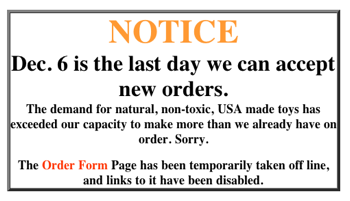
Recent news about lead-tainted toys manufactured in China have been helpful to one segment of the toy industries: small companies making hand-crafted toys in the US. But it's hard for small operations to gear up to meet unexpected demand, so we see - for example - things like this from a toymaker in Maine:

toynote.png

This is probably a one-year bounce for these folks, and I hope they've made the best of it. One might criticize them for having to stop taking orders on December 6, but then again, I don't think anybody makes wooden toys in Maine by hand to dominate the toy universe; my guess is that that owners of this business do what they do for a love of their work and some lifestyle choices, as well as to pay the mortgage.

So here's hoping that after this busy season they're able to take a nice vacation. The one bit of advice I'd have for them: they should people who are interested in their toys to leave their contact information so that they can be notified when the company is ready to take orders for upcoming birthdays, special events, and of course next year's holiday shopping season.

It's very hard to turn a windfall from someone else's problems into a long-term gain, but there is an opportunity here.

An interesting note: as I was reading about this, I found this article about how European toymakers have also benefited. But the first toymaker mentioned in Playmobil - not exactly a mom and pop operation. Europe is not exactly a hub of low-cost manufacturing; how is it that Playmobil makes its toys so close to home?

Turns out that it's a business consideration:

Schauer said Playmobil, a family-owned company in Zirndorf, Germany, faced intense pressure to move production to China. Most of the industry was moving there, she said, and German banks did not want to lend money to companies to build toy factories at home.

What the companies discovered, though, was that while China's unit labor costs were a fraction of those in the West - the equivalent of $1.50 an hour compared with $30 an hour in western Germany - the distance between China and the companies' biggest markets eroded some of that cost advantage.

In addition, Lego and Playmobil need to respond quickly to fickle consumer demand. To speed up the production of a surprise hit - a Playmobil World Cup soccer player, for example - would be costly in China, where factories are set up to churn out vast volumes of toys with long lead times.

"Toys are not the fashion business, but they are like the fashion business," Padda said. "The need to be able to react to what is going on in the market made us choose" Europe.


And so if you give a kid in your life Lego this year, it was likely made in Denmark. Because when a company makes these outsourcing decisions, cost isn't the only factor.