... if you're still following the Opinionated Marketers here, we've moved!
The new site is http://opinionatedmarketers.com and the new feed location is http://opinionatedmarketers.com/feed/.
See you there!
... if you're still following the Opinionated Marketers here, we've moved!
The new site is http://opinionatedmarketers.com and the new feed location is http://opinionatedmarketers.com/feed/.
See you there!
We've moved the blog to our own domain and WordPress. So, if you're seeing this post, please go over to the new blog and check it out. All of the existing posts and comments have been migrated over. We're still rebuilding things like our lists of links, but all new material will appear over there. WordPress will also let us add information pages like background on us, resources, and so on, so we're excited about the upgrade.
The new RSS feed is here.
The template we're using was designed by Nathan Rice, who has some great stuff available free (in the finest open source tradition!) and who also does custom WordPress work. Have a look at his stuff!
See you in our new digs.
For openers, I have to admit that I rarely drink anyone's coffee, let alone Starbucks' coffee, which I really don't like the taste of. (Some people I know claim that one of the reasons that Starbucks junks up its coffees with the latte-sugar-whatever stuff is to disguise that taste.)
As for coffee, sometimes I have a cappuccino - generally when I'm out to dinner or am taking a walk in Boston's North End and stop in at the Caffe Vittoria for a cannoli and to play oldies on their juke box.). Sometimes I drink iced coffee (generally from Dunkin' Donuts).
When I do go into a Starbucks, mostly it's to meet someone. I really do enjoy the coffee house ambience, and laud them for that (although, quite snobbily, I'd always rather spend my time and money in a stand-alone, non-chain place like Caffe Vittoria or Athan's Bakery in Brookline, Massachusetts).
Once a summer, or so, when I'm in a calories-be-damned mood, I have been known to indulge in a Frappaccino. Although when I'm in that kind of mood, I'm more likely to indulge in a Mochaccino at DD. (While I give Starbucks props for providing places to hang out in many of their stores, I'm just more of a DD kind of girl. Maybe it's that they're local, and I grew up with DD. Every Sunday, after Mass, my father would stop in at the DD in Worcester's Webster Square, just down the street from our church, and pick up a dozen donuts. Or two.)
Wherever I am, I mostly drink tea.
Which is a long-winded way of bringing up Starbucks testing an 8-oz. cup of joe that will retail for a buck. (In typical Starbuckian fashion, the 8-oz.-er has a cutsie name. It's called a "short.")
As reported in the Boston Globe the other day (Following up on an article that appeared in the prior day's WSJ),Starbucks is facing some caffeinated competition from McDonald's and Dunkin' Donuts, which offer premium (and frou-frou) coffee for less than the $2 or so something similar costs at Starbucks.
While the company issued a statement that their small gulp "short" is "not indicative of any new business strategy," you've got to ask yourself just what it is.
As a tactic to recession-proof themselves from regulars who might start questioning the wisdom of spending large for a "grande", I can't imagine that it's going to work. Someone who's become addicted to the Starbucks' experience is probably not going to feel relieved and grateful that they can keep buying there without spending big bucks. I'm guessing that they're going to feel short-changed, miffed, and tiny bit humiliated. (Now all the world can see: I can no longer afford to buy my coffee at Starbucks.)
They may already be doing this, but what might work better to secure their base is the buy-10-get-1-free cards that some places employ. (Two that I frequent are Cosi, where I buy salads for lunch a couple of times a week; and Copley Flair, a small local card store chain where I buy all of my greeting cards, not just because they carry a good selection, but because I get my card punched each time I buy one.) Loyalty programs do work.
As a tactic to bring in new customers, I can't imagine that this will be a big draw for McDonald's or Dunkin' Donuts patrons who like the coffee they're getting there just fine.
Last year, Starbucks' Chairman Howard Schultz warned against Starbucks "'watering down' its brand." More recently, he stated that the new offerings Starbucks has been coming out with aren't "'exciting'" enough.
The short strikes me as both watering down the brand and as decidedly non-exciting.
Is anyone over at Starbucks listening to their own Chairman?
The other day I wrote about my furnace repair guy who had an instinctive understanding of how to monitor and measure his marketing activities. It might have sounded like an overstatement to say that he was better at this than some marketing pros. Not really.
Just after the furnace fun I put an ad on Craigslist looking for somebody to do SEO work. The ad explained what we were looking for in a couple of paragraphs, how we'd want to relationship to work between us, an SEO person, and our clients, and requested that people in a specific geographic area only respond.
Five minutes later I got my first response: someone sending me his graphic design portfolio, with an LA phone number. (LA was not the location specified.)
His work wasn't bad... but I wasn't looking for a graphic designer, and he apparently hadn't read the ad. (The response came so quickly that I wondered if he had some method of monitoring Craigslist postings and sending automated replies.)
Then I got something from somebody else, in the wrong place, that instead of telling me anything about him, said basically "Why did you specify that location in the ad?" (Um, because I want someone in that location?)
Last night I got something from a company in India, and this morning I got something from somebody with a Yahoo address that told me about his or her SEO work, but did not have a link to their site, a name, anything.
People who do SEO are, one would presume, marketing oriented people. Wouldn't you think they'd have some idea how to present themselves?
Here are the basic, Marketing 101 rules that they broke.
This is not complicated stuff. I just want to know that you heard me, you understood me, and that you are responding to what I asked. But it's very important. If you can't comprehend what I asked you and reply appropriately, do you think I want you with a mile ofmy clients?
And these are people who are supposed to be providing marketing services. Scary. I'd rather have the furnace guy take a crash course in SEO and put him to work on it; knowledge can be acquired, but the ability to listen and think is usually either there, or not.
Not to take anything away from polymath geniuses like Ben Franklin and Thomas Jefferson, but it sure must have been a whole lot easier to know everything when there wasn't all that much everything to know.
And not to compare the average marketing person of yore to Ben Franklin and Thomas Jefferson, but I'm sure there was a day and age where an experienced marketing person could pretty much know just about everything there was to know about the elements of marketing.
But as with everything else these days, those days - if they ever really existed - are likely coming to a screeching halt.
I started thinking about this when I read one of John's recent posts in which he wrote,
So here's a recommended new year's resolution for 2008: don't throw out the past and don't forget history. Old media still matter (and in some market segments, matter more than new media). For marketers, the trick is to remember the whole picture - not just the most exciting shiny and new parts of it.
While John's post had a specific angle to it (he was talking about audience size), the more general point can be made that marketers need to incorporate "the new" (online advertising, social networks,SEO, e-mail blasts...) into their bag of tricks, without letting go of "the old" (print advertising, direct mail, live events....). Just because there's new stuff to know doesn't mean that we can or should toss out the old.
This makes life more demanding for marketers.
There's a whole lot more to know about these days - and as the pace of change accelerates, it's just going to get harder and harder to keep up with everything. Thus, we will see more and more specialization within marketing.
To some extent, this is nothing new. Most of us have specialized in some way shape or form: We do B2B, or consumer, or non-profit marketing. We develop expertise in PR, or direct marketing, or marcomm, or product marketing.
But I have a sense that it will become less and less possible for people to utter the words I've spoken on more than one occasion: "I've done everything on the marketing continuum, from write specs for a product to assemble the trade show booth."
In fact, as more and more gets added to the marketing continuum, it becomes less and less true for me. I've done a bit of SEO and e-mail marketing, but virtually nothing with - say - building an on line community.
Say, maybe "they" were right and the Internet does change everything...
So what's a marketing professional to do?
Whether you're a solo practitioner, individual contributor, or marketing manager, you need to make sure that you keep up with what's new and exciting in marketing.
No, you don't need to become an expert in everything that's new and exciting. You just need to know a bit more than that it exists. You need to know what "it" is and what "it's" used for. You need to have at least a vague idea of whether you even need "it." And you need to know who would do "it" for you if you needed "it" done. In other words, you need to know what you don't know. (And not draw a complete "duh" blank when someone asks you about one of the new-fangled ways of doing marketing.)
Clear enough for you?
The point is that there's a growing body of things to know about in marketing, and not all that much that has (yet) fallen off the table.
Sure, there are virtual trade shows - but there are still physical trade shows, and if you pick your spots and work them well, they can be excellent venues for finding new customers. Sure, there are online communities - but there are also user groups, where your most rabid customers gather in the flesh, and want to hear from you about what's new and exciting. Sure, there are opt-in e-mails, but there's also good, old-fashioned paper-based direct mail campaigns.
In fact, I can't think of one thing that I was doing twenty years ago in marketing - other than print thousands of copies of the new brochure - that I wouldn't also consider doing today. Trade shows. Direct mail. Breakfast seminars. User groups. Collateral. Sales tools. Advertising. PR. They're all still in the mix - it's just that mix has gotten more intricate and more complex.
If you're a marketer who's been around for a while, make sure you keep your awareness level of "the new" high, but don't necessarily abandon the areas where you're the expert. You never know when a twenty-something will need your help, say, assembling that pesky trade show booth.
Yesterday was a chaotic day at my house - the furnace died late last week, just in time for a weekend of lows in the 30s. Yes, I'm a New Englander, Houston winter should never be a problem, but come on - cold damp weather in a typically badly insulated Gulf Coast house is not a fun time. Long story short, an entirely new furnace and duct work went in today.
At one point I was chatting with the technician who was running the show, and we started talking about marketing. "I'm a marketing buff!" he said. And you know what - he sure is.
He was talking about how aggressive the salespeople for yellow pages ads were, and I said, "Are the ads worth it?"
"Oh yeah," he said, and explained why. And he knew his stuff. He had actually set up a system so that when new customers call, they track what ad they saw. He'd figured out what percentage of those calls result in business, how much that business is worth on average, and come up with a number for the value of the average inquiry from a yellow pages ad. So he could easily count the calls and decide if the ads were worth running.
Folks, I've worked at $100 million dollar companies doing B2B advertising that can't do that.
You don't have to be one of the big guys to get this stuff right. You just have to think about the process from inquiry to sale, and pay attention to how it's working, and attach some metrics. Yes, it can be more complicated that this. But the guy installing my new furnace today was brighter about this than some marketing execs I've known.
This is the fourteenth in a series of posts on Practical Product Management Rules from Pragmatic Marketing.
Pragmatic Marketing Rule #14: Look for opportunities to deliver the remarkable.
I'll have to admit, when I saw that word "remarkable" my first thought was, 'is this one of those annoying words like passionate and personal brand that pop up from time to time to test my gag reflex?'
But that first thought was fleeting.
This is, after all, Pragmatic Marketing we're talking about here, and they strike me as an outfit that's long on the clear, the thoughtful, and the practical - and blessedly short on the buzz-word BS.
And the PM folks are right on. As product marketers and product managers, we should want to deliver the remarkable in whatever we do - remarkable in the sense of wonderful, uncommon, and singular - all definitions that I just found in the nearby dictionary. (But not so nearby that I'm willing to go look up just what sort of dictionary it was. So there'll be no sixth grade essay "According to Webster" stuff going on here.)
Think about it for a minute.
If you settle for "good enough" in your product, and don't make sure that there are at least a few nice to have goodies, your customers will greet the news with "it's about time," and your prospects will greet the product with "big deal - you've just got what everyone else has."
Is this the type of response you want?
No, you want your customers and prospects to have some sense of delight - something they hadn't thought of, something that's a bit out of the ordinary, something that they'll find really useful - or at least interesting.
It could be something as simple as a last minute time or grief saving feature someone thought of. Maybe it's a smooth integration with some tool or application that everyone in your target industry uses, but which has never really connected up all that well with anything else. Or something that's all new, first ever, state of the art - but something that everyone is going to be clamoring for any day now. You just got their first.
(With product related "remarkables", try to make sure that they're real. The last thing you want is a "who cares?" reaction from customers and prospects.)
The first place to get remarkable should never be playing with prices or services, but, let's face it, your remarkable "thing" could be a couple of hours of installation support thrown in - not because installation is such a bear - let's hope you've solved that problem - but because every environment's different and anything can happen. Or extending the number of seats the license will support.
Don't forget that you can be remarkable in your sales process by really and truly listening to what your prospects and customers are saying, and responding to them. (Years ago, when sifting through vendors to design and build my company's new web site, I gave four companies a detailed outline of what I wanted them to cover when they came in and gave their pitch. Nothing all that radical or out there, just something that addressed the questions and concerns I had. From my point of view, I was handing them gold on a platter by telling them exactly what I wanted, and saving them the time of soliciting this information on their own. But out of four companies who came in to pitch us, only one used the information I'd provided them. The others just went through their standard sales presentation - not bad, but entirely formulaic and not what I'd asked for. Do you have to ask who got my business? I didn't think so.)
You can be remarkable in your customer service process as well. Maybe it's a check-in phone call to follow up on whether last week's problem has been resolved. Or a call to welcome a newbie to the family.
Don't forget the finance side of things, either. Believe me, a lot of customers would find it quite remarkable if you contacted them to let them know you'd discovered an overcharge. Or that more attractive financing was now available.
It's a tough world out there. In order to get noticed - and get business - you need to do something to stand out. And it really doesn't have to be all that remarkable. Last week, I posted on the fine customer service I got at Best Buy/Geek Squad, capped by the original customer service person I spoke with seeing me wandering around the store an hour later, and asking me if I was all set. Maybe not all that remarkable in absolute terms, but compared to some of the don't make eye contact, gab with your fellow clerk, not to mention outright rude retail behavior we're all occasionally subjected to...Will I go back to Best Buy? You best believe I will.
So, don't forget to deliver the remarkable. It really does work.
Having recently joined the fortunate ranks of those not burdened with urban car ownership, I am now among the ranks of those who on occasion have the need to rent a car.
One such occasion occurred last week, when I had to go to Syracuse on business.
Now, Syracuse is not the easiest place to get to from Boston unless you're willing and able to drive, and I've always driven there. It's not a bad drive, if 300+ miles can be categorized as not bad. It's pretty much a straight shot out the Mass Pike to the NY State Thruway, and iPod in (one) ear, the drive goes by relatively fast.
But in order to drive, you must have a car. Which I no longer do.
Thus, I rented.
The closest-best rate-best pick-up and drop-off times was at an Avis about a 10 minute walk from where I live.
Avis it was.
The sign up on the web was fine. The service was fine. The car was fine. No one tried to ram collision (covered by my credit card - I called to check) down my throat. The hardest thing about the whole thing was trying to remember what a metallic green Taurus with Pennsylvania plates actually looks like in a parking lot. (Answer: pretty much like ever other metallic green car.)
A couple of days after I returned the metallic green Taurus, I receive the following e-mail from Avis.
Dear Maureen Rogers,
As you know, we at Avis think there's nothing more important than offering you an enjoyable rental experience. So, as we thank you for providing your email address on your recent car rental, we'd also like to invite you to receive email communications for future discounts, electronic receipts and money saving tips.
It's easy, simply go to avis.com and enroll in the Wizard program to create a profile. It will help you make future reservations even faster - and is just one more way we try harder to make your rental experience the best that it can be.
Be sure to include your email address in your profile and check "yes" to opt-in to receive promotional emails and e-Receipts so you can:
Receive automatic e-Receipts for easier expense management
Get the latest news, promotions and offers from Avis
We look forward to delivering you an even more enjoyable rental experience.
Sincerely,
Becky Alseth
Senior Vice President, Marketing
P.S. For an even faster rental experience, sign up for Avis Preferred® Service so you can skip the lines and go right to your car. It's free.
Just what do I like about this?
First off, the subject line indicated that they were asking for permission to market to me. No beating around the bush, just straight out telling me that they'd like to have me as a customer - a customer who gives them permission send e-mails.
Okay, I won't be letting me know about "the latest news, promotions and offers from Avis." Frankly, I only care at the very moment I need to rent a car. So I will never look at those e-mails - save your bandwidth for someone who will.
But I will probably sign up for the Preferred Service - which will let me "skip lines". And is FREE. Which means that I'll more than likely just go to Avis up the street, as opposed to Hertz across the park, when I need a car.
Pretty smart marketing, I'd say.
Maybe they do try harder. In this case, they succeeded.
Mary Schmidt has a post up about one of the great marketing delusions: the idea that people just love, love, love seeing ads all the time.
Commenting about Microsoft's concept of streaming ads to shopping carts in the grocery store, complete with RFID so it can tell you about Pop-Tarts when you're in the breakfast aisle - because heaven forbid you have a few minutes in the day to just be lost in your own thoughts! - she writes:
The corporate bla-blah speak justifying streaming video ads to shopping carts is classic: “This is not all necessarily about bombarding consumers, about targeting advertising,” said Scott Ferris, general manager of Microsoft’s Advertiser and Publisher Solutions group. “It’s about also making the shopping experience better for the consumer.”
No it's not. It's about selling more stuff.
People are actually quite tolerant of advertising. They are, however, not stupid, and when you tell them that the reason your shopping cart is getting in your face with ads is to improve your quality time at the store, they are likely to think, "What kind of moron do you think I am?"
For example, does Forbes think they're fooling anyone with this?

"Skip this welcome screen?" It's not a welcome screen, it's an ad. I know that. I get it. Free content, ads. Fine. But every time I click on a link to a Forbes article and see that, I think - yes, that's right - "What kind of a moron do you think I am?"
This is what every marketer needs to remember:
1. When you're beaming a one-way message at someone to get them to buy something, it's an ad. I don't care how you send it, what the medium is, how much you drape it in trappings of social media, or how much you personalize it. It's an ad. That's OK, but don't forget it.
2. People don't really want to hear it. In the case of Forbes, they want to read an article, not an ad. In the case of the shopping carts above, people just want to buy their Cheerios and milk and bananas and go home.
3. So if you want people to pay attention to your ad, it needs to be useful, entertaining (or at least interesting), and not annoying.
People are remarkably tolerant of ads, even as they invade every bit of our mental space, and when they're very good they are treated like valuable cultural artifacts. But they are not tolerant of being treated like idiots.
You're a marketer. Don't delude yourself into thinking that there's a world full of consumers sitting there thinking, "I wish my shopping cart would tell me about the special on Acme Fried Sugar Crisps" or "Oh, Forbes is welcoming me - they're so friendly!" Just do your job and show some basic respect for peoples' intelligence.
Oh, and on that shopping cart thing - it's just the incentive I need to check out the farmer's market up the road I keep hearing about. It used to be that the worst thing about shopping was annoying muzak. Now, instead, a trip to Kroger is an assault on the senses. There are constant chirpy announcements about what I should be buying. There are screens on the registers showing videos and animations, and making beeps and boops that always make me think my phone is chirping at me - "Did I just get a text message? No, it's the $@#$#@ register again."
My big complaint about all of this is quite simple: everyone is so busy bombarding us with some message or another that there's less and less time to just be with yourself. You know - to daydream, to think about what you'll do later in the day, to suddenly wonder about that old friend you haven't heard from in years, to be struck by a creative idea. I am a marketer, but I do believe that all of these new methods of interruption marketing are basically making us into a group of stupider and stupider people.
I also think it's annoying people, and eventually the backlash will come. Professions that don't have the common sense to restrain themselves wind up being restrained by somebody else. We get what we ask for.
A week ago Saturday, tired of keeping my HP laptop going by holding the overheating and poorly working power jack in at just the right angle, and worrying about whether the whole thing was going to turn into a not so towering inferno, I decided to get a new laptop.
Off to Best Buy I took myself, where we were helped by a very pleasant and knowledgeable sales guy named Doug, and a couple of very pleasant and knowledgeable guys at the Geek Squad downstairs, whom I paid to load software, remove bloatware, etc.
I no sooner got my new and beautiful Sony Vaio home - and, yes, I do know that I paid a premium for a laptop that looks nice, but amortized over the life of the machine (even if it's only 2 years), etc... - than it started flaking out. Big time.
We're not just talking blue screens of death the likes of which I haven't experienced since Windows 3.0. We're talking freeze ups when trying to do anything: write files to a DVD, work with a wireless mouse, write a blog entry. And not just any old freeze ups, but deep freezes accompanied by black outs. And ding-ding-ding's.
Scary stuff, especially when you're over 300 miles away from home - on business, of course - and you can't just walk back to the Best Buy on Newbury Street to return it.
When I started to experience all my laptop woes, it is little exaggeration to say that the top of my skull was about to fly off. (John and Sean are my witnesses here.)
I called Best Buy on Newbury Street and, since Doug wasn't there, I spoke with Bill and let him know what happened - and that I'd be in on Friday evening for an exchange.
On Friday evening, a perfectly pleasant young woman in Best Buy customer service - whose name I didn't get - listened to me rant and then went over to the Geek Squad with me. Soon we had Doug, Pete, and one of the other Squadders to hear my rant - and to quickly jump in and get that replacement for me - no questions asked.
They didn't even make an attempt to convince me to have them look at the laptop, which I was grateful for, since I wasn't willing to go that route. They just took my word (and my word.doc, on which I'd provided a running list of my week's worth of problems).
No, none of us thought this was a Vista problem. We all thought it was a hardware problem of some ilk.
While I wandered around Best Buy waiting for the Geeks to reinstall and deinstall files, I ran into the first Customer Service person I'd encountered, and she asked whether I was all taken care of, which was a nice touch.
In any case, I was soon on my way with a new working machine - yes, another Vaio - that has now gone 2 1/2 days without a freeze up or blue screen of death.
So long, bad little Vaio, you were beautiful on the outside, but rotten on the inside...You are going back to Sony-Land, where you belong (once they wipe out my files, which the Geeks assured me they would do).
Props to Best Buy and their resident geeks, the Geek Squad. Whatever experiences others have had there, mine was a good one.
P.S. Maybe it's just another pretty face, but I do like the look and feel of Vista, as well as the 2007 Office apps, now that I'm getting used to where everything is.
If you use Twitter regularly, you've probably noticed that it's not the most reliable of web apps. Yes, it's free, and sure, you have to expect some glitches... but compared to other services, it's pretty dicey.
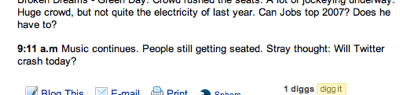
We are getting a demonstration of that right now. I'm looking at ZDNet's updating blog page of Macworld keynote reports and I saw this shortly after it started:
Sure enough, a few minutes later...
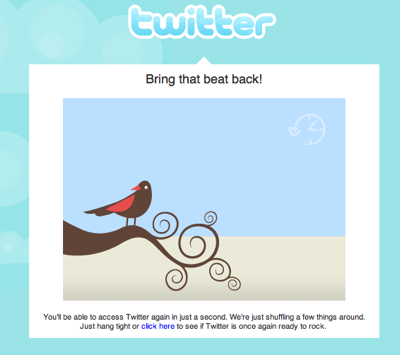
(Twitter did indeed come back in a few seconds, as the message promised - but only in that there was a page there. No new tweets on it - it seems to just not be updating anymore, which frankly is no more useful than the error page.)
I like Twitter, but I have to say, I'd never make it the centerpiece of any time-sensitive social media strategy. You just never know when everybody is going to see an overly-cute "Oops! It's broken!" message instead of the application itself. Given that its makers appear to have no plans to make it into a sustainable enterprise (read: something with money to invest in infrastructure), this is unlikely to change.
It's a great concept, though, that will probably be implemented much better at some point. Maybe by Twitter, but quite possibly not.
Things move fast in the world of social media. So fast, in fact, that Tuesday's hot new thing is often Friday's old news. So I chuckled when I read my first Twitter is, like, so yesterday post.
I am SO sorry for writing this, I L-O-V-E Twitter. Love it! I’m just so sorry to say, Tumblr replaces it. It’s that simple. Tumblr is to the iPhone what Twitter is to the pager. I know, I know. I love Twitter and I have been obsessed with it for almost a year now so I KNOW what Twitter is supposed to be, thank you - it’s SUPPOSED to be like a pager, that’s the DNA of what Twitter needs to be to do “microblogging”…I once said. And Pownce (which I love too!) and Jaiku (which I neglect, Im so sorry!), are all not what I’m talking about either, Twitter does best what those other apps do.
Tumblr, on the other hand, is enhanced in the right way and thus, unfortunately, and yet also for the better, replaces the need for Twitter all-together. This is going to be hard for people to see because Pownce could be seen as an attempt to enhance Twitter but actually Powence further illuminated the superior simplicity of Twitter, i.e. that the kind of enhancement doesn’t work. Perhaps unwittingly, and more likely just consequently, Tumblr enhances Twitter in the right kind of way.
The missing piece here - the right kind of way for what? I like Twitter because it's incredibly simple and people I know use it. Tumblr does more, but it's nothing that I want to do or am not doing elsewhere. (Obviously, this isn't true for the writer above... and that's fine.)
I have a Tumblr account, by the way; I'm not linking to it here because I'm boycotting anybody who drops the "e" from "er." No, not really; there's just nothing there, so there's no point in pointing anybody at it.
Finding a use for the next social media tool is, to be blunt, not high on my list of priorities. The tools need to find my needs; if I don't have an unmet need, I'm not interested.
And that's the bigger point: the platform du jour for blogging, microblogging, sharing links and feeds, and so on will change tomorrow, and next week, and next month. As any IT product marketer knows, feature advantages are incredibly hard to maintain; fortunately, they're not usually the point.
Twitter, for all its popularity, is something that a couple of Google developers could recreate in an afternoon and have live in a week. (And it would probably be more reliable on day one than Twitter, which always has the feeling of being held together with duct tape and prayers.) What Google couldn't duplicate that quickly is the user base.
Here's what matters for all of these tools: do people find something useful to do with them? Do they have a critical mass of users? And finally, perhaps most importantly, are the information and network links in them accessible from the outside world?
The nice thing about most of these platforms is that if you don't care to become a hardcore user, you can still get what you need from them through search and RSS feeds. I think we're going to see people get less interested in investing time and effort into using them if that's not possible (hi, Facebook!).
The missing piece is the social graph. If you've got a network of links to others in LinkedIn or Facebook or Twitter, that doesn't move easily somewhere else. That's got to change.
This is the thirteenth in a series of posts on Practical Product Management Rules from Pragmatic Marketing.
Pragmatic Marketing Rule #13: Every "product" needs a product manager and a business case.
In my experience, most B2B technology companies do a pretty good job with making sure that all their products have a product manager. Of course, sometimes the product manager ends up with multiple products - which is okay, especially if they're on the smallish side and in the same family, but which can lead to product attention deficit if the products are on the biggish side and not all that related. But, mostly, products tend to have product managers.
Which is a good thing.
But those business cases....
Products start out in many ways.
Sometimes the product gets developed by someone who thinks it's a good idea and just goes ahead and does it. (This happens with special regularity in the wonderful world of software.)
In this case, the product manager may find the product flying (metaphorically) over their (metaphorical) transom, and find themselves tasked with creating a business case. This tends to be a bad thing. Here you have a product that may have been a good technical idea. Or a good idea in general. But now you have to figure out the positioning: who it's for, what they do with it, and what it does for them. In a far, far better world, all this will be figured out before the product is created.
Sometimes a product starts out with a business case. Which is a good thing. But then, somehow, the business case never gets updated. It may never even get looked at. It is/was "just" the hurdle that product management had to leap over in order to get the darned thing developed.
This approach is a bad thing.
If you don't bother to regularly update - or even create anew - your product's business case you run a lot of dangers:
We all know how easy it is to keep chugging along, doing the same thing quarter after quarter, year after year. If you're a product manager, you probably know this drill by heart. You do your job. You take care of all the basics and cover all the bases: product requirements - check; documentation - check; QA - check; project plan - check; product launch - check; sales tools - check; sales training - check; etc - check.
It's so darned easy to never take the time to critically examine your product's raison d'etre - and really figuring out whether there's enough raison to keep the d'etre going.
Product managers, it's never too late.
If you have products that last had a business case made for them in ought-four, time to create one. And trust me, you may have some tiny little fear that a business case will end up putting your product out of business, as it were. And putting your job at risk.
Truly, this is a remote, remote possibility and, in fact, the best way to make sure it doesn't happen is to make sure that the product(s) you manage have a strong case behind them.
So what are you waiting for? Get going! You should have a business case for your product, if not on you at all times, at least within fingertip reach.
The unexamined life is not worth living, and, in the end, the unexamined product is not worth managing.
A while back I heard the phrase "email bankruptcy," which describes the state some people reach when their inbox contains thousands of messages that they simply cannot cope with. The mere sight of it is paralyzing, and so sometimes people simply "declare bankruptcy" and delete them all - then send a message to everyone in their address book announcing that all email is gone, and anything important was there, please re-send it. And then the hapless victim of email overload vows to do better.
Apparently T-Mobile is having this problem. A week or so ago I sent an email to their Hot Spot customer support group with an account question. It wasn't a critical issue; I signed up for the service with a term commitment, and I wanted to know when it ended. That's information that I should be able to see when I log into my account on their site, but they don't provide it, so I asked.
I finally got a response:
Dear Valued Customer,
Thank you for taking the time to contact T-Mobile HotSpot regarding.
I greatly apologize for the delay in response. We are currently experiencing a high volume of e-mails. Your comments, concerns and questions are very important to us and we would like to see your issue satisfactorily resolved. For prompt assistance, please contact our Customer Service Department anytime 24 hours a day, 7 days a week at 877-822-7768. Again, I greatly apologize for the delay and for any inconvenience you have experienced.
Hello, T-Mobile? If you'd like to see my issue satisfactorily resolved, answering my question would be a great idea. And if you have people standing by to talk to me on the phone, couldn't some of them answer the email waiting for responses?
Here's the kicker:
Please feel free to contact us by email or at the number below if you have any further questions, comments or concerns.
So, they've sent me an email to tell me they aren't answering email anymore, and they're inviting me to respond to them by email.
It's not often that a multinational telecommunications provider is able to make themselves seem so completely amateurish. I get the feeling that T-Mobile is really Gunther and Inge in somebody's garage trying to keep the wheels flying off the whole enterprise.
Really sad.
I saw a post on yesterday's Boston Filter on Polaroid's new inkless printer, the exceedingly cool Polaroid product that was announced at this week's Consumer Electronics Show (CES) in Las Vegas. It's so exceedingly cool, I wrote about it over on Pink Slip. It's so exceedingly cool, I zipped on over to the Polaroid web site to find out more about it.
Now, maybe this exceedingly cool new product is not all that exceedingly important to Polaroid. Or maybe, because the show opened earlier in the week, it's not all that exceedingly hot any more.
But there was no info on the home page.
There was a home page link to some info about Polaroid's presence at the CES, where the Digital Instant - that exceedingly cool new printer - was showcased along with a couple of other Polaroid products. And drilling down on the CES link there was a small fact sheet on the product, and a couple of pictures, but not much else.
So I clicked on the Printer choice on their list of Featured Products. Which led to an empty screen that told me:
There were no results matching your search criteria.
Well, that was no help.
Now, I would assume that a lot of people who attended CES, not to mention a lot of the people who saw product coverage, would be heading to the Polaroid site for more info. Maybe not. Maybe I'm the only one who wanted to learn more.
Now, maybe Polaroid has a rule about not putting much/any info up about products until they're officially released.
But wouldn't you think that there'd be some exceedingly easy-to-get-at info on this exceedingly cool new product.
Or is this a case of what happens in Vegas, stays in Vegas?
Busy in upstate New York meeting with my fellow opinionated marketers this week, so I'll just offer you this video, which anybody who's spent time with salespeople should appreciate:
A few weeks ago, a client asked me to check out a blog post on a topic related to his technology. For the life of me, I can't remember what company the blogger worked for, but it was someone big - Microsoft, Cisco, that level.
The post was well written and informative. I looked at a few other posts by the guy. Well written. Informative. Regular commenters - not tons, but some.
Clearly he was putting a lot of time and effort into being "out there."
Clearly, it was a big part of this guy's job to create an online presence.
Clearly, my client was feeling a bit of blogger envy. He didn't exactly come out and say it, but I could hear it in his e-mail voice: "Why can't we have a blog like this? Wah, wah, wah."
Sorry, but unless someone of the folks already working 14 hour days wants to add a 15th blogging hour on "for free", and unless everyone else can add a bit to their work day to feed your blogger ideas, or unless you force everyone in the company to write one post every week (whether they can write or not): IT'S JUST NOT GOING TO GET DONE.
And it probably wouldn't be worth the effort to begin with. There's a certain size company (and customer base) where blogging will start to make sense, but that size is probably not 10 employees and 5 customers (or vice versa).
Even if you're God's gift to the blogosphere, you probably won't find that the people who matter - in your case, your prospects and customers - probably won't read you all that regularly.
But there's no reason that my client can't start moseying around in and exploring the blogosphere by:
Second-hand blogging (or first-hand blogging, for that matter) is not going to be the panacea for all of your companies visibility and awareness raising ills. But by spending a bit of time up front figuring out where you want to start commenting, and minimal time each day/week reading and commenting on your favorites, you will begin to get your company's name - and yours - out there in a low cost manner that could well end up yielding your benefits.
And if there's no one person in your teensy-tiny company who wants to take on full commenting responsibility, how about putting blog grazing on the agenda for your weekly team meeting or group lunch? Many mouths, many brains can make light work of keeping up with the blogs that matter.
David Reich's MarketingProfs piece on blog video makes a great point: blog videos are often a great way to lose the attention of your audience.
Is it any wonder, then, that I find my mind wandering as I watch a blogvid that runs on? How many of us have the time, ability or budget to produce a slick video to post? Most of what I've seen so far have been talking heads, perhaps with some props, but still basically talking heads. Deadly on TV and, to me, hard to watch on a blog if it runs too long.
What's too long? To me, much more than a minute or perhaps two is it. Even if the verbal content is good and well-delivered, it becomes a challenge to watch as it gets longer. I start looking for the toolbar to try to zip it ahead.
For my online friends who have been doing vids, I say this with all due respect and ask your understanding. I'll still watch your vids, because I do want to hear what you have to say.
BUT, why can't it be said the old-fashioned way of blogging...in writing? If it's written, it's easy to re-read a sentence or paragraph for clarity, before I post a comment.
I'm with David. The written word is an amazing tool. You can use words to communicate all kinds of complicated ideas. They get subtle shades of meaning across. They can be printed out for later reference. They can easily be emailed to colleagues. You can read them on a plane. You can read them on your mobile phone. You can read them during tedious conference calls. You can read them without disturbing the person sitting four feet from you.
And they're a random access medium. The reader can skip ahead, go back and re-read something. She can skim at high speed or carefully focus on every word. They put the user in control and as a result are probably the most user-oriented medium there is.
Video has its place. Video can show you things that would be hard to follow in a written description; the video that Apple put on its site as a promo for the iPhone is a great example (it convinced me to buy one because it made it obvious how many features worked, and it served as a quick start guide when I got the phone home). I'm not saying video is bad.
I'm just suggesting that if you can't figure out why you shouldn't be using a simpler, lower-bandwidth, more flexible, and more user-controlled medium for your message, then you shouldn't be making a video.
At the risk of sounding judgmental, it's highly self-indulgent. Look, I can make a video! Look, I didn't have to bother to organize my thoughts and write them down; I'm just going to talk at you! When I'm on the receiving end of that stuff, my strongest reaction is that this communicator has no respect for me or the rest of his audience, and I usually stop watching.
Video has its place. It's just turning up in a whole lot of other places lately. A good maxim: use the simplest possible medium for everything. You will probably still find yourself using video - but the videos will be better and more meaningful for your audience.
This is the twelfth in a series of posts on Practical Product Management Rules from Pragmatic Marketing.
Pragmatic Marketing Rule #12: The answer to most of the questions is not in the building.
When I first began working at Genuity, a temporarily high-flying Internet Services Provider of the dot.com era, I was struck by the fact that rank and file marketing people rarely had access to customers and prospects. I came to Genuity from a small software company, where I had regularly gone on sales calls, spoke with customers frequently, and, in general, spent a fair amount of time poking around outside the building.
Genuity - at $1B a year in revenues (and losses) - was quite a bit larger than Softbridge, which in our last full year as an independent company did about $7M in business. At Softbridge, we all wore multiple hats. As VP of Marketing, I ran (and sometimes was) product marketing, marcomm, and product management). At Genuity, I just did product marketing. And product marketing just didn't get all that many opportunities to get out in the field.
In my three years there, I went on a handful of calls. Our sales model was multi-layered, and there were often 3-4 folks from sales alone on a call. No room in that clown car for another body! If sales brought another body along, it was typically a technical expert or a product manager.
I participated in many events, speaking on behalf of Genuity, and thus was able to have some engagement with customers and prospects, but it was limited. I also met with some regularity with industry analysts - another good source of insight and info. But I really craved customer and prospect interaction that I just wasn't getting enough of.
Several times I created customer surveys, but I was not allowed to speak with customers directly - I had to go through multiple layers of the customer support organization.
All in all, it meant for a very high frustration level in which I always felt I had my nose pressed up against the window glass, able to see but not communicate with the customers on the other side.
Fortunately, I developed good relationships with enough of the technical sales folks and sales engineers to get my questions answered, but it was not really the same as building good relationships with customers, or hearing first hand what prospects were saying.
You really do need to get out of the building to truly understand how people use your products and services, to appreciate the benefits they derive from them. You need to get out there to see what parts of your message customers respond to - and what parts draw blanks - or leave them cold.
Obviously, you also need to get out to gauge what's happening in the economy and technology in general, and with your industry, your market, and your competition in particular. (Some of this intelligence you pick up by being out and about with customers and prospects. But fortunately, even if you don't have access to them, you can still get this information, you can still find an awful lot out. [For purposes of this argument, let's assume that purposeful wandering around the Internet counts for getting out of the building.])
None of this is to say that there's not important "stuff" that you can and should find out within your own four walls. There are definitely people who know things within those walls, and you should know who they are - and how to tap their minds. But, when it comes to it, there's really only one question that can only be answered inside the building, and that's "how does it work?"
Kim Hart of the Washington Post wrote about niche social networking sites, and why they may be more appealing for marketers:
Overall, ad spending on social-networking sites is expected to grow 75 percent next year, to $2.1 billion, according to eMarketer, a research firm that tracks online advertising. With more than 110 million active profiles on MySpace and 59 million on Facebook, those sites still attract the lion's share of attention and money, winning more than 70 percent of all U.S. social-network ad spending in 2007, according to eMarketer.
But smaller sites' share of that money is growing. Of the $920 million spent this year to advertise on social networks, 8.2 percent went to niche sites, up from 7 percent in 2006, according to eMarketer. Next year, niche sites' share of ad revenue is expected to grow to 10 percent, according to an eMarketer report released this month.
That shouldn't surprise anybody. More focused online communities are likely to attract more targeted audiences. Users are also likely to spend more time there and be more loyal to them, whereas there's a flavor of the month feel to MySpace and Facebook. (Facebook in particular seems intent on alienating its users, whether it's through creepy tracking and public revelations of personal information like Beacon, using members' pictures in ads, or ham-handedly insisting that user's personal data belongs to them. I think the clock is ticking for them.)
Smaller sites are also more likely to have the flexibility to work with marketers to create customized advertising programs. Users are more likely to care who's supporting their beloved online forum.
The main value that large networks like Facebook bring is the ability to keep track of social connections. But we're already seeing others trying to build those capabilities into things like email, contact management, and calendar applications. That will continue, and the value proposition for something like Facebook for its users is likely to weaken. When social networking is an omnipresent feature, no a destination, those smaller networks and sites become even more important - and if you're already there, you'll be ahead of the game.
